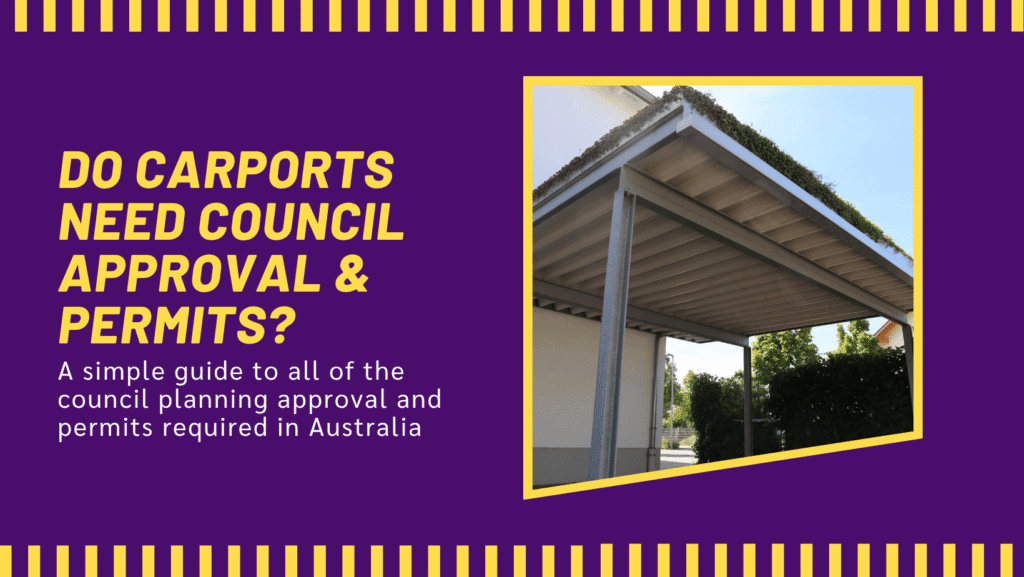
Do Carports Need Council Planning Approval & Permits?
Looking to build a carport and not sure whether you require council approval or permits to do so?
Whether or not you can build a carport without council or planning approval is determined by the size, type, and location of the carport that you are planning to build as well as the state or territory in which you reside.
This simple guide spells out all of the council planning approvals and permits that are required when building a carport in Australia.
South Australia (SA)
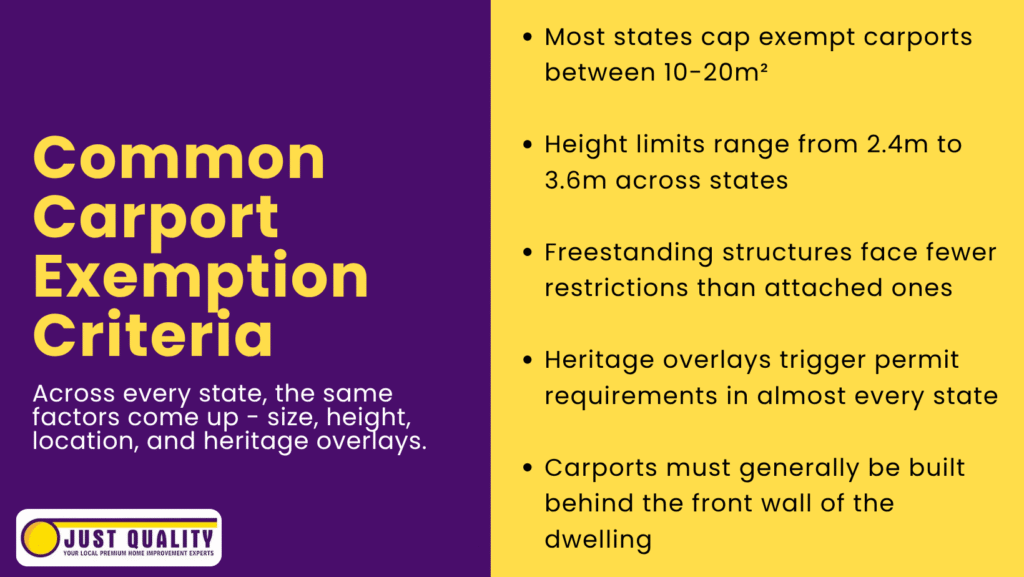
Building a carport in South Australia (SA) generally won’t require approval under the Planning and Design Code so long as it meets the criteria listed below:
Dwelling type: It is associated with a single residential dwelling (not units or commercial sites)
Structure type: The carport must be entirely freestanding
Area: The total roofed area is 15m² or less (or 10m² or less in a Historic Conservation Zone)
Height: Not higher than 2.5m above natural ground level
Post spacing: The distance between support posts does not exceed 3m
Location: It must be built behind the main face of the house so it does not change the streetscape view of the house.
Setbacks: At least 900mm from a secondary street boundary and at least 6m from a road intersection
Overlays: The property is not located in a heritage-listed area or affected by special planning overlays.
Queensland (QLD)
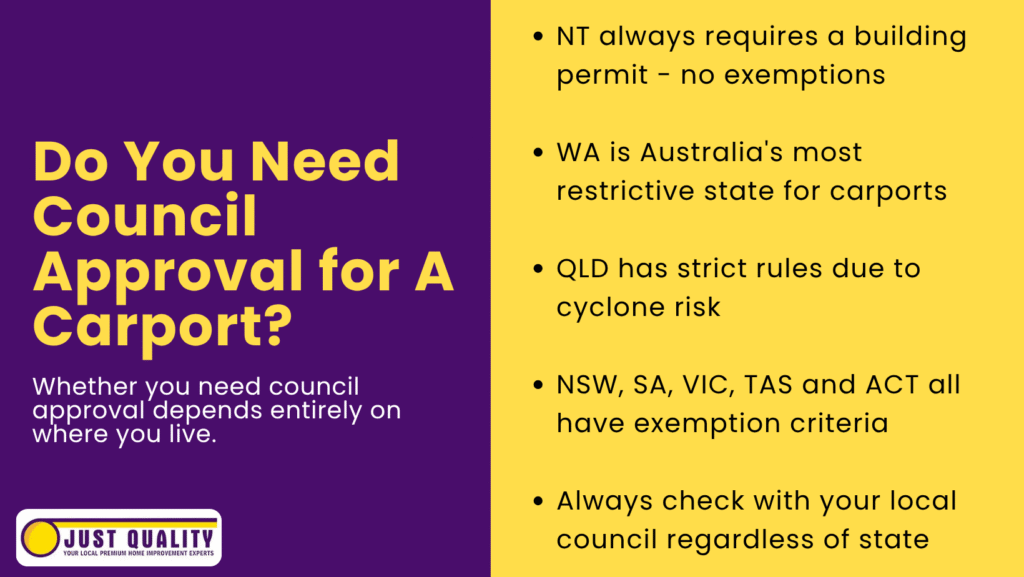
Building codes and restrictions around building carports in Queensland are amongst the strictest in Australia due to the cyclone risks faced by properties across parts of the state. Under the Queensland Development Code, a carport is classified as a Class 10a building. Most carports will require building approval, but exemptions can apply where the structure meets all of the following criteria:
Area: Must not be larger than 10m²
Height: No higher than 2.4m at the highest point, with a mean height no greater than 2.1m
Dimensions: No side is longer than 5m
Structure type: Must be freestanding and not attached to the dwelling
Setbacks: Must be at least 1.5m from side and rear boundaries and 6m from the front boundary
Overlays: The property is not in a heritage, character, flood, or bushfire overlay
New South Wales (NSW)
Council planning/permit approval is generally not required to build a carport in New South Wales if the following criteria can be met:
Area: Floor area is no greater than 20m² on lots up to 300m², 25m² on lots larger than 300m² in residential zones (excluding R5)
Height: No higher than 3m above existing ground level
Setbacks: At least 1m behind the building line of any road frontage and at least 900mm from each lot boundary
Openness: Two or more sides open with at least one-third of the perimeter open
Materials: Metal components must be low-reflective and factory pre-coloured
Heritage: Not located on a heritage item, in a heritage conservation area, or on land in a foreshore area
Limit: One carport per dwelling (two if there is both a primary and secondary dwelling)
In NSW more than any other state or territory in Australia it is essential to check with your local council as some areas and local councils may be subject to different rules. We cover these considerations before building a carport in a separate guide.
Victoria (VIC)
In Victoria, under Schedule 3 of the Building Regulations 2018, a building permit is not required to construct a Class 10a carport when all of the following criteria can be met:
Area: Floor area is no greater than 10m²
Height: No higher than 3m, or no higher than 2.4m if located within 1m of a boundary
Structure type: It is freestanding and not attached to another building
Location: Located further back than the front wall of the main dwelling
Materials: Not constructed of masonry
Overlays: Not located in a heritage overlay, environmental overlay, or neighbourhood character overlay
Easements: Not located over an easement or asset of a relevant authority
Note: Even where all of the above criteria can be met, a planning permit from your local council may still be required before constructing a carport so it’s important to check beforehand.
Western Australia (WA)
Building approval is required for almost all carports in Western Australia (WA). The only time when a carport is exempt from a permit is when it can meet all of the criteria under Schedule 4 of the Building Regulations 2012:
Area: Floor area does not exceed 10m²
Height: No higher than 2.4m
Structure type: It is a freestanding structure
Wind region: Not located in wind regions C or D as defined in AS 1170.2
Location: Built behind the front setback of the property (front-yard carports almost always require planning approval)
Setbacks: Meets the Residential Design Codes (R-Codes) for setbacks from side and rear boundaries
Western Australia is the most restrictive state in Australia when it comes to building carports. Carports in Western Australia are also assessed against the R-Codes. Front-yard or boundary carports almost always require both planning approval and a building permit.
Tasmania (TAS)
Tasmania uses the “Categories of Building Work” assessment criteria to determine whether or not a permit is required when building a carport. Carports that fall within the “Low Risk” Category 1 classification are exempt from requiring a permit, provided they meet all of the following criteria:
Area: Carports cannot be larger than 18m² (or up to 36m² if it is a prefabricated structure)
Height: Walls are no higher than 3.6m
Structure type: It is a single-storey, freestanding building, not attached to a dwelling or another residential structure
Setbacks: At least 900mm from boundaries, especially the secondary street boundary
Easements: No building work undertaken within 2m of an easement or other infrastructure
Overlays: Not located in a bushfire-prone area or on land subject to heritage or environmental overlays
Notification: Owner must complete a Form 80 – Notice of Low Risk Work on completion
Australian Capital Territory (ACT)
In the ACT carports are classified as “small open structures”. Under the Planning (Exempt Development) Regulation 2023 and Schedule 1 of the Building (General) Regulation 2008, a carport may be exempt from requiring both a Development Approval (DA) and Building Approval (BA) if it can satisfy the following criteria:
Area: Max 10m² on blocks up to 500m²; larger thresholds apply for bigger blocks
Height: Max 3m above datum ground level (up to 4m if no part exceeds a 30° plane from the boundary)
Structure: Unenclosed Class 10a with no walls
Floor level: No more than 0.4m above datum ground level within 1.5m of a side or rear boundary, or 1m elsewhere
Setbacks: Meets side and rear boundary setbacks under Schedule 1
Heritage: Not on a heritage-listed property or in a heritage precinct
Northern Territory (NT)
The Northern Territory has no specific exemptions when building carports. A building permit is always required when building a carport in the Northern Territory.
To obtain a building permit, you must engage an NT-registered building certifier or an approved self-certifying manufacturer.
Related Articles
Are Automated Outdoor Blinds worth it?