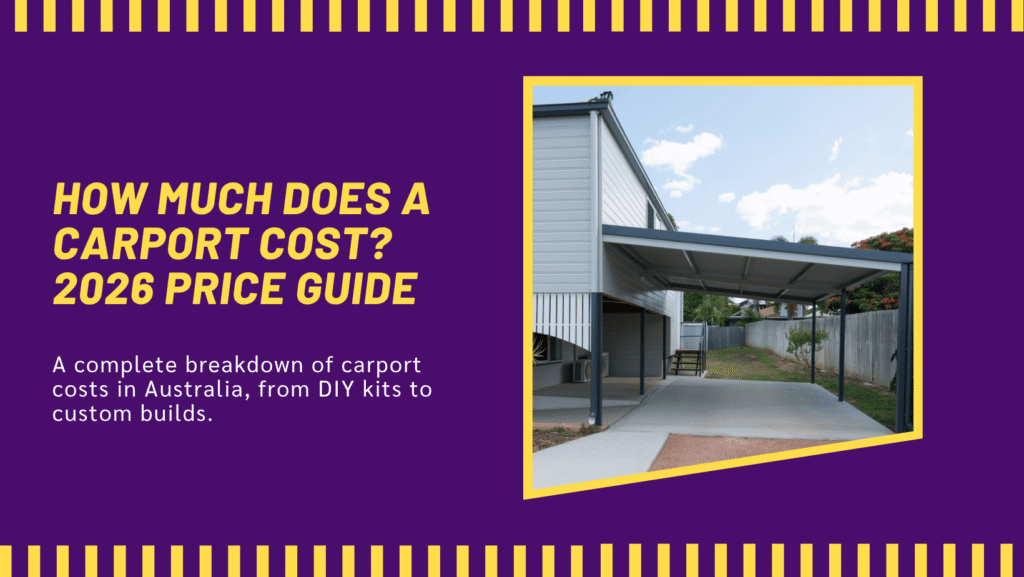
How Much Does a Carport Cost?
Interested in building a carport, and want to get an idea of costs involved?
Carport costs can vary dramatically depending on DIY vs professional services, materials used, and different supplier quotes. Like anything in the construction and home improvement space, it’s important to get a sense of average costs involved, so you can budget accordingly.
This article will break down the average costs involved in building a carport, kits vs custom builds, single vs double carports, when a permit is required, and the factors that impact pricing.
Table of Contents
- Average Costs
- Carport Kits vs Custom
- Single/Double Carports
- Council Approval & Costs
- Other Factors That Affect Costs
Average Carport Costs in Australia
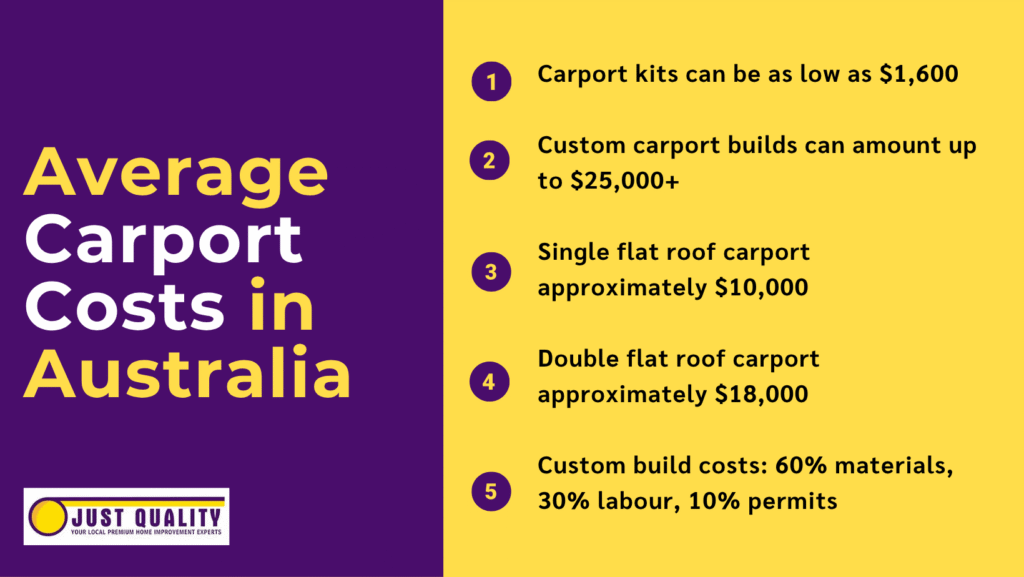
The average cost of building or installing a carport in Australia is between $1,600 and $25,000. Carport kits can be as low as $1,600, and custom carport builds can amount up to $25,000+ for the full construction.
The costs involved in building a carport will depend on the level of customisation, single vs double carport, materials used, and the labour required. Carport kits are inherently a lot cheaper than a custom carport build – and naturally, the quality of a kit cannot be compared to a custom, made-to-measure carport construction.
Carport Kits vs Custom Carport Build
Carport Kits
If you Google “Carport Kit” you’ll likely see a number of cheap, DIY carport kits available to purchase online for $1,600 up to $8,000. The premise of these products is that you can get the materials delivered directly to your home, pre-cut and ready to go based on the product sizing. As of early 2026, the cheapest carport kit available online is ~$1,600 and includes a steel-based outdoor structure that can be erected and built at home, but is not secured to anything.
Other kits will direct buyers to anchor carport kits securely to a concrete slab, which is not supplied as part of the kit purchase.
The hidden costs of a carport kit include:
- Materials and supplies for a concrete slab
- Local council approval and permit (depending on your local governing council)
- Labour – most kits require 2-3 people to assemble the carport, ideally a qualified builder or carpenter
- Eventual replacement – cheap carport kits are not built for longevity and will eventually require replacing
There’s also the risk of damage – to your property, or your car. At the end of the day, what seems like a cheap, DIY option, will always mean compromising on quality, or having to spend on labour and extra materials.
Custom Carport Build Costs
A custom carport will involve a specialist home improvement or building company coming out to your property, measuring and assessing the dedicated space, and building a custom carport. It will involve consulting with the builders, design and permits, and construction – among other considerations when building a carport.
Custom carports can cost between $10,000 and $25,000, depending on the size, layout, and overall design of the construction. A custom carport will also offer additional features that a kit can’t match – built-in storage, lighting or power outlets, and a secure, sound structure.
A breakdown of costs for a custom carport:
- Materials: 60%
- Labour: 30%
- Permit, plans & design: 10%
Total costs: Between $10,000 and $25,000, depending on the style, features, and site foundations of your new carport. Here are some examples:
- Single flat roof carport approximately ~$10,000
- Double flat roof carport approximately ~$18,000
- Single gable roof carport approximately ~$15,000
- Double gable roof carport approximately ~$22,000
Single vs Double Carport Costs
A single carport will be inherently cheaper than a double carport build, typically ending up costing 30-40% less at the end of the build. A single carport build could be as low as $10,000, whereas double carport builds start at $18,000.
A single carport generally means a minimum of 3m wide, by 6m long. A double carport will mean being large enough to fit two standard vehicles, with a minimum size requirement of 6m x 6m.
Carport building regulations will vary between local councils and from state to state. Here’s a breakdown of the permission required to build a carport in Australia:
South Australia: Generally, council approval will be required to build a carport in SA. Any structure with a roofed area, if:
- The carport’s roof area exceeds 15m² (10m² if in a Historic Conservation Zone).
- The carport height is 2.5 metres or higher, above natural ground level.
- The distance between supporting posts is more than 3 metres.
- The carport is attached to another structure, such as an existing building or fence.
- The location of the carport could impact visibility or traffic safety, especially at road intersections.
- The carport is positioned in a way that affects neighbouring buildings (e.g. it obstructs their view or access to sunlight).
- The property is located within a heritage-listed area.
In South Australia, building assessment for structures like carports is charged at $149 or 0.25% of the total development cost, whichever is greater.
Queensland: Building approval is generally not required if the carport is:
- Less than 10m² in size
- In a residential zone
- Not impacted by a relevant overlay
- Not impacted by a neighbourhood plan
In QLD, carports are classified as Class 10a structures and building approval is handled through a private building certifier rather than directly through council. Fees are set by individual certifiers and will vary.
New South Wales: Generally won’t need local council approval, as long as the structure is compliant with development standards. Local councils may vary depending on bushfire, conservation, or public land zoning. Floor area must not exceed:
- 20m², on lots with an area of 300m² or less, or
- 50m², for lots larger than 300m² in rural zones and residential Zone R5, or
- 25m², for lots larger than 300m² in other zones.
- The carport must not be higher than 3m above ground level (existing).
Where a complying development certificate is required, fees are set by the certifying authority – fees are reviewed annually.
Victoria: Carports will require council approval when:
- The floor area is more than 10m²
- The structure is taller than 3m or 2.4m within 1 metre of the boundary line
- It’s located at the front of the property, in-front of the main house
Victoria uses a tiered structure for carports/Class 10a structures. Building permit fees for garages, carports and sheds in Victoria are:
- $815 for builds under $5,000
- $1,105 for builds under $10,000
- $1,810 for builds under $20,000
- $2,085 for builds over $20,000
- A state government building permit levy is also payable on projects valued over $10,000.
Western Australia: yes, development approval is required for carports.
Building permit fees in WA are calculated at 0.32% of the estimated construction cost for residential work and outbuildings, with a minimum fee of $110. A Building Services Levy of 0.137% of the construction value (minimum $61.65) also applies on top of this.
It’s important to check your local council’s regulations as each LGA may have different requirements.
If you work with a dedicated carport company, they will generally submit the required documentation for council approval.
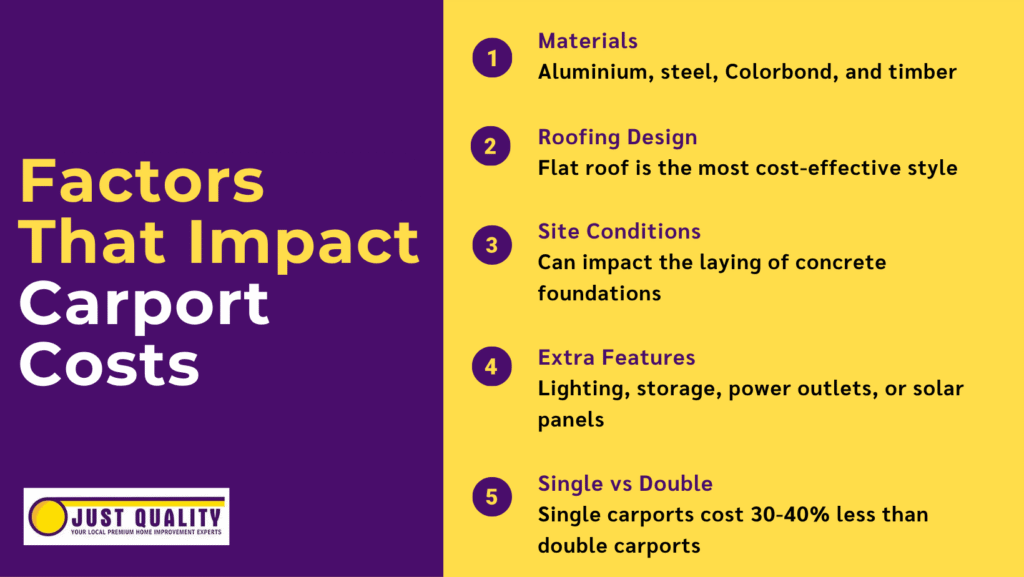
Other Factors That Impact Carport Costs
Materials
The materials involved will naturally determine overall costs. Most common materials include aluminium, steel, Colorbond, and timber – in order of least to most expensive.
Roofing Design
The overall design and roof line of your new carport will impact total costs involved. At Just Quality, we design and install a variety of different style carports, including:
- Flat roof
- Gable end
- Skillion/reverse flat roof
- Hip roof
- Dutch gable
A flat roof will be the most simplified structure and cost-effective style, followed by a skillion/reverse flat roof. Gable end roofing, hip roofing, and dutch gable roof carports will lean towards more expensive than flat roof carports, due to increased materials, more labour required, and complex engineering.
Whether or not the roofing is then attached to another building (the home) or completely detached will also impact costs. Free-standing carports are typically more cost-effective.
Site Conditions
Site conditions can impact the laying of the concrete foundations, and therefore, overall costs. If you have an existing concrete slab or driveway, there may be extra preparation required.
Extra Features
Additional features included in the build like lighting, storage, power outlets, or solar panels can increase the cost of installing a new carport.
Related Articles
Are Automated Outdoor Blinds worth it?