Do Outdoor Blinds Reduce Heat?
Outdoor blinds offer varying levels of light filtering and shade for outdoor spaces.
Considering that the afternoon sun can heat local temperatures to well over 40°C (especially in arid parts of South Australia and tropical Queensland), reducing the amount of heat that radiates into the home is an important factor for everyday comfort.
Reducing heat with outdoor blinds also translates to a lower energy load for air conditioning and related electricity bills – something that all homeowners can appreciate.
So, how effective are outdoor blinds at reducing heat from the Aussie sun, and how do they compare against indoor window coverings like curtains and blinds for heat management?
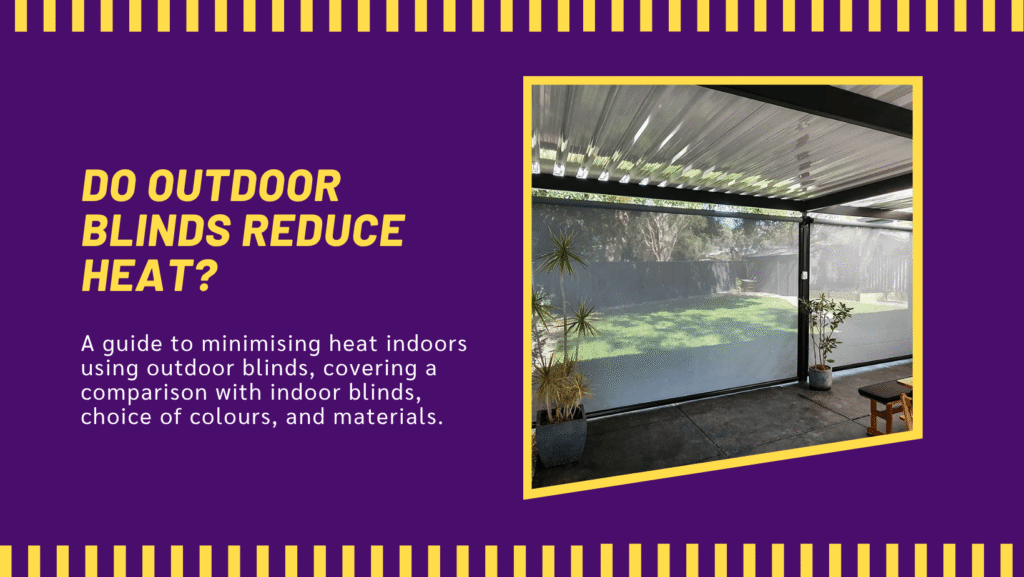
This is a guide to minimising heat in the home using outdoor blinds, covering a comparison with indoor blinds, choice of colours, and materials.
How Effective Are Outdoor Blinds At Reducing Heat?
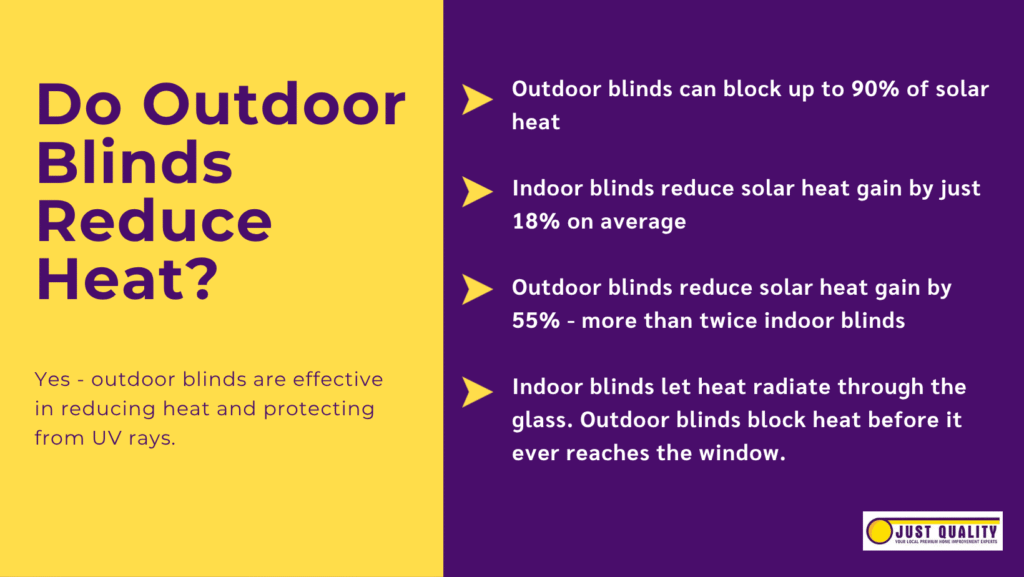
Outdoor blinds are one of the most effective window covering solutions for reducing solar heat gain – more so than indoor window coverings.
YourHome, the Australian Government’s guide for sustainable home planning, provides clear evidence that effective shading from outdoor blinds can block up to 90% of solar heat.
Without any shade, radiant heat from sunshine passes through glass windows and is absorbed by building elements and furnishings, which then re-radiate inside the home. Outdoor blinds block sunshine and radiating heat from entering through windows and into outdoor spaces, making spaces feel cooler while also offering protection from UV rays.
Comparing Indoor and Outdoor Blinds for Heat Reduction
Both indoor and outdoor blinds reduce heat by directly blocking sunlight. However, there is a big difference in the amount of heat reduction between the two types of blinds.
According to the Department of Energy, indoor blinds can reduce solar heat gain by 18% on average. Outdoor blinds were found to reduce solar heat gain by 55%, more than twice that of indoor blinds.
Indoor blinds have a lower heat reduction because they are positioned on the inside of windows – meaning that sunlight still hits the glass. Some heat still radiates into the home through the gap between the glass and the indoor blinds. Not only that, but indoor blinds absorb some solar heat, which is also radiated indoors over time. The same applies to other indoor window coverings like curtains – this is a big reason why it can still feel hot and clammy indoors even after drawing the curtains closed.
Outdoor blinds are positioned to block sunlight before it reaches the windows. Solar heat is either reflected off the surface of the blinds or absorbed by the blind material and dissipated outside the home.
Best Outdoor Blind Colour for Heat Reduction
Just like a home’s roof and walls, the colour of outdoor blinds can affect how much heat is blocked.
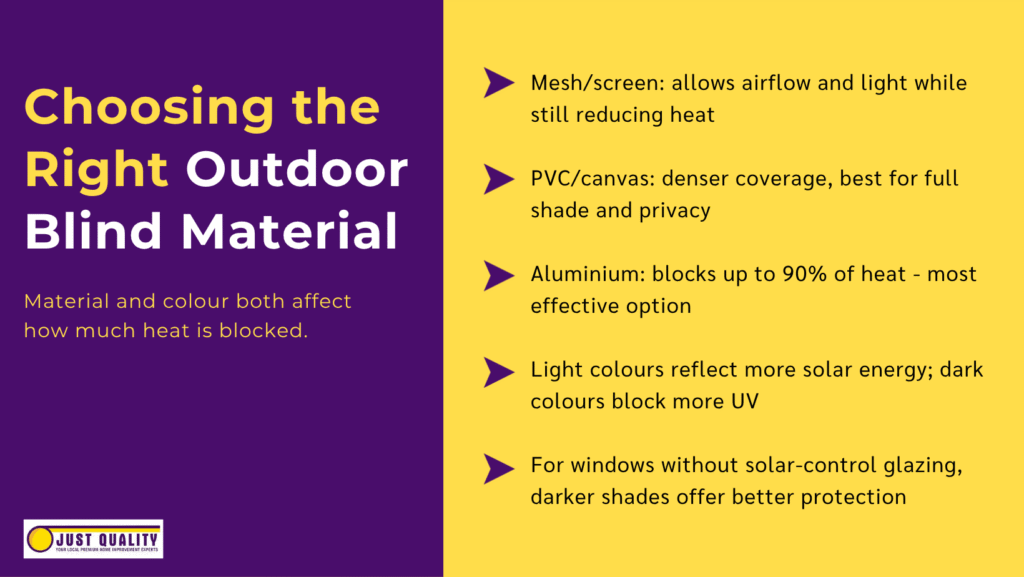
Lighter colours like white or tan reflect solar energy more effectively and reduce heat absorption. Darker colours absorb more heat, but offer greater protection from UV rays and sun glare.
Light coloured outdoor blinds are usually recommended, but the reality is that heat absorption matters less for coverings outside of the home. For homes with windows that lack low-E or solar-control glazing, the increased UV protection from a darker shade may be more beneficial than the negligible difference in heat absorption.
Outdoor Blind Materials for Reducing Solar Heat
The material of an outdoor blind plays just as big a role as colour in how well it manages heat. Different fabrics and finishes provide different degrees of sun exclusion, air flow, view and durability, so it depends on the priorities for each particular space.
Mesh and Screen Fabrics
Mesh and screen fabrics are the most common choice in Australian homes for external blinds. Mesh material provides heat reduction while allowing light and air to pass through, keeping spaces cool without completely blocking natural light.
The amount of heat blocked depends on the openness of the fabric, which is expressed as a percentage. A tighter mesh fabric blocks more heat and light, and vice versa. A typical mesh fabric percentage for homes is 95% shade cover with a 5% open weave.
If the priority for a certain window is privacy or a maximum sun blockage, mesh fabrics with 99% shade cover are available.
PVC and Canvas
PVC and canvas fabrics are denser, more tightly woven materials often used for awnings and fixed outdoor blinds. These fabrics block more direct sunlight than open mesh and suit spaces where full shade and privacy are the priority over view-through.
PVC is available in open and closed weaves, so it’s worth considering whether the goal is to have some daytime visibility or for complete coverage.
Aluminium
Also known as roller shutters, aluminium blinds are extremely effective at reducing heat transfer into the home. Roller shutters can reduce solar heat by up to 90%.
Aluminium stands up well to weather and allows for adjustable shading, especially when combined with automated solutions. This makes aluminium systems especially useful on east and west-facing windows, where the low angle of the morning and afternoon sun is difficult to manage with fixed shading alone.
The trade-off is that aluminium blinds are completely opaque and offer no visibility when closed.
Related Articles
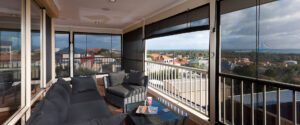
3 Benefits Of Installing Ziptrak Blinds
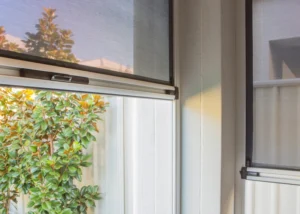
Are Automated Outdoor Blinds worth it?