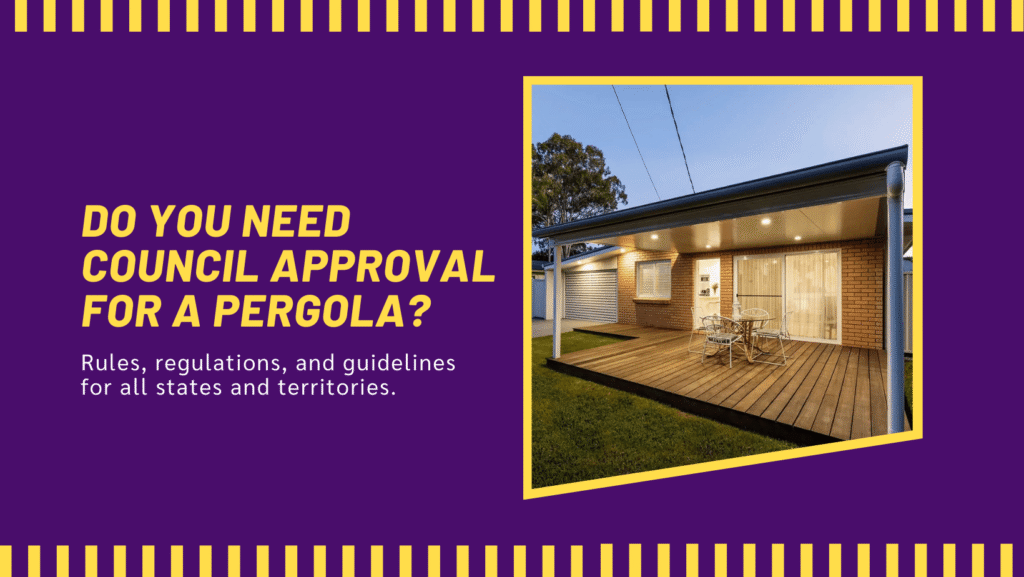
Do You Need Council Approval for a Pergola?
Looking to build a pergola but not sure whether you require council approval?
You’re not alone – thousands of Australian’s are adding a pergola to their home each year. To make sure you’re doing things by the books, it’s important to understand the local laws and approval processes that are required. Failing to follow local guidelines can result in fines and even require the structure to be removed from the property.
To make things simple, we have put together a breakdown of pergola planning regulations for all states and territories in Australia. If you’re also considering a carport, find out whether your carport needs council approval before you start planning
It’s important to remember that different states and territories have different rules and regulations. Within those states and territories, certain councils may have different regulations which is why it’s essential to check with your local council before building.
Pergola Laws & Regulations – State & Territory Breakdown
South Australia (SA)
If you are looking to build a pergola in South Australia (SA) you generally do not need a planning permit or council approval under the Planning and Design Code when it meets the following criteria.
- Dwelling type: It is associated with a single residential dwelling (not units or commercial sites)
- Location: It is built behind the front building line (not in front of the house)
- Structure type: It is open-roofed and not enclosed (no solid roof, ceiling, or solid walls)
- Area: Generally up to around 20m² in total size
- Height: Not higher than approximately 3m above natural ground level
- Setbacks: At least 900mm from side and rear boundaries
- Overlays: The property is not heritage-listed or affected by special planning overlays (heritage, character, flood, bushfire
Whether you’re planning a simple flat-roof structure or something more elaborate, we build timber pergolas in Adelaide and steel pergolas to suit pergola budget and council requirements.
Queensland (QLD)
Queensland has stricter building codes due to cyclone risks. You usually don’t need a permit if:
- Area: It is no larger than 10m²
- Height: No higher than 2.4m.
- Dimensions: No side is longer than 5m.
Note: Most “standard” pergolas exceed these, so many homeowners use a private certifier to get a quick building approval.
New South Wales (NSW)
The following rules apply to balconies, decks, patios, pergolas, and verandas in New South Wales. If you are building a pergola in NSW, you will generally not require permission when the following criteria has been met. Before building, it is important to check with your local council as some areas and local councils may be subject to different rules.
- Area: It is no larger than 25m² or 15% of total dwelling size
- Height: No higher than 3m above ground level at the highest point. Floor must be no more than 1m above ground level.
- Walls (if enclosed): Must be no higher than 1.4 metres
- Setbacks: It is at least 900mm from the property boundary.
- Heritage: It is not in a heritage conservation area or on a heritage-listed property.
Victoria (VIC)
In Victoria, you can build a pergola without council approval if all of the following criteria are met.
- Height: It is less than 3.6m high.
- Area: The pergola is less than 20m² in floor area.
- Location: The pergola is located further back than the front wall of the main house.
- Roof: It must be unroofed. If you add a roof, you will likely need a building permit.
- Heritage: The pergola must not site over an easement or in a heritage overlay
Western Australia (WA)
In Western Australia, you do not need council approval to build a pergola if all of the following criteria are met and the pergola is free standing and not subject to special heritage planning permissions.
- Area: It is not larger than 20m² in total size
- Height: Under 2.4m high at the highest point
- Frontage: If you build in the front setback (the “front yard”), you almost always need planning approval.
- Location: Pergolas must not be attached to a dwelling or in a heritage area
Tasmania (TAS)
Tasmania uses the “Categories of Building Work.” to determine whether a permit requires approval before building. As a general rule, A pergola is usually deemed to be “Category 1 (Low Risk)” and is exempt from requiring approval if it can satisfy all of the following criteria.
- Area: The pergola has a floor area of 18m² or less. Not that some councils may allow up to 36m² so it’s important to check with your local council.
- Height: No higher than 3.5m.
- Roof: Must be unroofed or covered with a permeable material
Australian Capital Territory (ACT)
The ACT classifies pergolas as small open structures – the same as gazebos and similar structures. Council planning/approval is not required when building a pergola in the ACT if all of the following criteria can be met.
- Area: No larger than 25 m²
- Height: No higher than 3m.
- Enclosure: It has no walls and is not attached to the house in a way that affects structural integrity.
- Location: Must be a freestanding structure – it cannot be attached to a house or similar dwelling on the property.
Northern Territory (NT)
The Northern Territory classifies pergolas as shade structures. A building permit is not required if the pergola can satisfy all of the following criteria.
- Use: It is for residential, non-commercial use only
Type: The pergola is a freestanding structure and not attached to the residential property or any similar structures on a residential premise. - Approval basis: It meets the exemption criteria under Regulation 3(2)(a)
- Compliance: It satisfies the requirements outlined in Building Note 114
Related Articles
3 Benefits Of Installing Ziptrak Blinds